Korean-Style Beef Salad
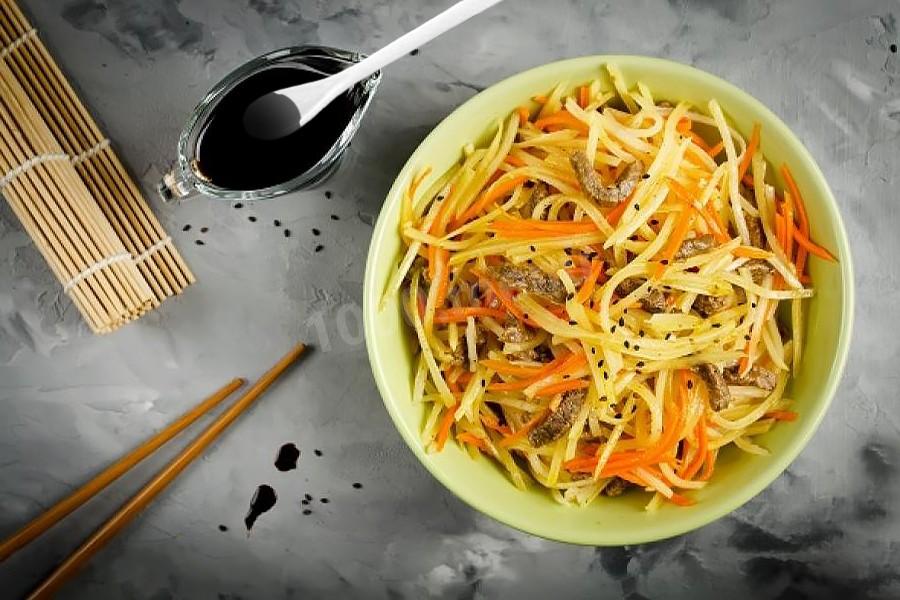
A seriously delicious dish! It's easy to make and fun to put together. Korean-style beef salad is a classic of Korean cuisine. It turns out so tasty and hearty that it's bound to become a family favorite. It works just as well for company as it does for a weeknight dinner — serve it as a side or let it stand on its own as a main.
Teena
Recipe author
Korean-Style Beef Salad
Nutrients and energy value of the composition of the recipe
By weight of the composition:
Proteins 27 %
4 g
Fats 33 %
5 g
Carbohydrates 40 %
6 g
80 kcal
GI:
83
/
0
/
17
- How do you make Korean-style beef salad? Start with the carrots. Wash and peel them, then shred them on a julienne grater (the kind used for Korean-style carrots). Mix together all the marinade ingredients, pour the marinade over the carrots, toss well, and let them sit for 25 minutes. Now the potatoes: wash, peel, and shred them on the same grater, then cover with cold water so they don't darken. In a pot, combine the pickle brine and the water (1 liter / about 4 cups), add a little salt, and bring to a boil. Drain the potatoes, add them to the pot, and cook for 2 minutes — they should soften on the outside but stay slightly firm inside. Drain in a colander. Cut the beef into thin matchsticks. Heat half of the vegetable oil in a skillet, add the beef, and fry until just cooked through (it goes fast). As it cooks, season with salt, pepper, and a sprinkle of ground coriander. When the beef is done (try not to overcook it), pour over half of the soy sauce and let it cook for another minute or so. In a large bowl, layer the potatoes and season with red and black pepper and salt. Press the peeled garlic through a garlic press over the top. Toss everything gently. Add the beef and carrots, drizzle with the remaining oil, and toss again. Finish with a sprinkle of sesame seeds. Serve with the rest of the soy sauce on the side. Enjoy!
- Every oil is only good up to a certain temperature — its smoke point, the point at which it starts to burn and form harmful compounds. Choose an oil with a high smoke point for frying, and use delicate oils for dressing rather than cooking.
- Keep in mind that soy sauce is quite salty, so cut back on the added salt to avoid over-seasoning the dish.
Caloric content of the products possible in the composition of the dish
- Ripe potatoes - 80 kcal/100g
- Baked potatoes - 70 kcal/100g
- Mashed potatoes - 380 kcal/100g
- Boiled potatoes - 82 kcal/100g
- Potatoes in uniform - 74 kcal/100g
- Fried potatoes - 192 kcal/100g
- Melted beef fat - 871 kcal/100g
- Fat beef - 171 kcal/100g
- Lean beef - 158 kcal/100g
- Beef brisket - 217 kcal/100g
- Beef - okovalok - 380 kcal/100g
- Beef - lean roast - 200 kcal/100g
- Beef shoulder - 137 kcal/100g
- Beef - ribs - 233 kcal/100g
- Beef - ham - 104 kcal/100g
- Beef - tail - 184 kcal/100g
- Boiled ham - 269 kcal/100g
- Beef corned beef - 216 kcal/100g
- Carrots - 33 kcal/100g
- Dried carrots - 275 kcal/100g
- Boiled carrots - 25 kcal/100g
- Garlic - 143 kcal/100g
- Ground black pepper - 255 kcal/100g
- Soy sauce - 51 kcal/100g
- Granulated sugar - 398 kcal/100g
- Sugar - 398 kcal/100g
- Wine vinegar (3%) - 9 kcal/100g
- Vinegar 9% - 11 kcal/100g
- Balsamic vinegar - 88 kcal/100g
- Apple vinegar - 14 kcal/100g
- Vinegar - 11 kcal/100g
- Vegetable oil - 873 kcal/100g
- Dried whole sesame seeds - 563 kcal/100g
- Shelled sesame seed - 582 kcal/100g
- Salt - 0 kcal/100g
- Water - 0 kcal/100g
- Ground red pepper - 318 kcal/100g
- Ground coriander - 25 kcal/100g
- Brine - 1 kcal/100g
Similar recipes


Related and additional categories:
- National cuisine
- Salads
- Meat and meat products
- Semi-finished products
- Vegetables
- Nuts
- Sweet
- Spices seasonings spices
- Fats and oils
- Other
- Garlic
- Кинза
- Pepper
- Salt
- Vinegar
- Vegetable oil
- Water
- Asian cuisine
- Cooking
- Frying
- Marinating
- In a frying pan
- Eggless salad
- Korean salads
- Vegetable salads
- Salad with vegetable oil
- Salads without mayonnaise
- Low-calorie dietary salads
- Salads with meat products
- Potato salad
- Soy sauce salad
- Beef
- Brine
- Sauce
- From carrots
- From potatoes
- No eggs
- Seeds
- Sugar