How to Cook Langoustines
Beautiful, delicious, nourishing langoustines on your table! Langoustines are often called big shrimp, but that's a big misconception. Langoustines are far tastier than shrimp, and the size of these sea creatures is impressive. Their meat is very tender with a slightly sweet taste. The key is cooking them right!



Cooking method
-
Step 1:
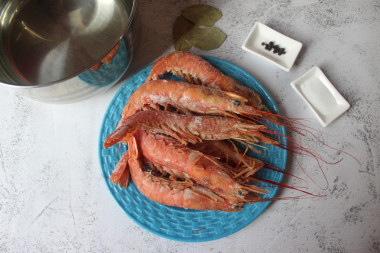
Gather all the necessary ingredients. I have Argentine langoustines of category L1, the largest size — these crustaceans run 20–25 cm long. There are also L2 and L3 langoustines, 15–20 cm and 11–15 cm respectively. Be aware that the size of the langoustines affects the cooking time. I don't recommend buying boxes labeled LR, which means the package contains langoustines of mixed sizes.
-
Step 2:
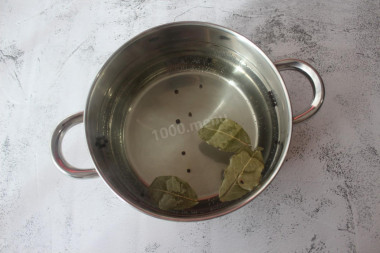
Pour tap water into a large pot, set it on the heat, and bring the water to a boil. Langoustines should be cooked in plenty of water, and it's best to use a large pot so the water doesn't overflow when you add the crustaceans. Add the bay leaf, peppercorns and salt to the boiling water and stir.
-
Step 3:
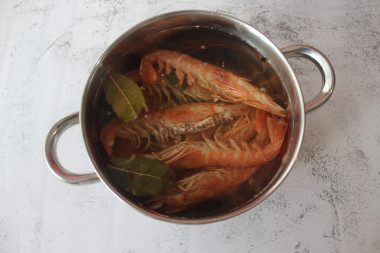
Lower the langoustines into the boiling spiced water. There's no need to thaw or shell them before cooking — this keeps the seafood juicy. You can add other spices, but be very careful, since langoustines readily absorb the aroma of the brine, garlic and herbs. When foam forms on the surface, skim it off with a slotted spoon.
-
Step 4:
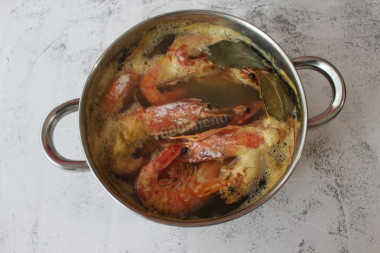
Cook the langoustines at a gentle boil. Since mine are pre-cooked and frozen (red color), I boil them for 2–3 minutes after the water returns to a boil. If the langoustines are raw-frozen (dark greenish color), they take much longer: about 17–20 minutes for category L1, 12–15 minutes for L2, and about 10 minutes for L3. Don't overcook langoustines — it hurts their sensory qualities (smell, taste and appearance).
-
Step 5:
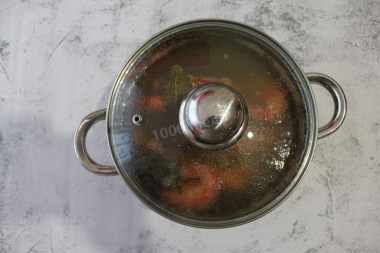
Take the pot off the heat, cover it, and let the langoustines sit for a bit. This lets the seafood soak up even more of the flavors. After a few minutes, use a slotted spoon to transfer the cooked langoustines to a platter.
-
Step 6:
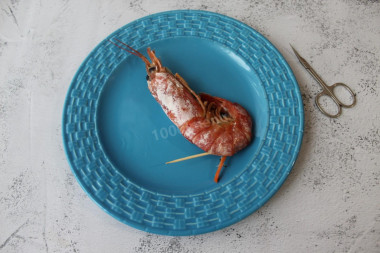
Since the shell wasn't removed during cooking, the intestinal vein wasn't taken out either. How do you remove the intestinal vein from langoustines? With scissors, carefully cut the shell along the whole back, spread the edges apart, and pull out the tract. It's quick and easy. It's a good idea to take the innards and shells straight to the trash, or the kitchen will start to smell off. When serving, you can sprinkle the langoustines with lemon juice if you like.


Caloric content of the products possible in the composition of the dish
- Bay leaf - 313 kcal/100g
- Black peppercorns - 255 kcal/100g
- Langouste (tail meat) - 88 kcal/100g
- Langoustine - 112 kcal/100g
- Salt - 0 kcal/100g
- Water - 0 kcal/100g