Toasts with Capelin Caviar
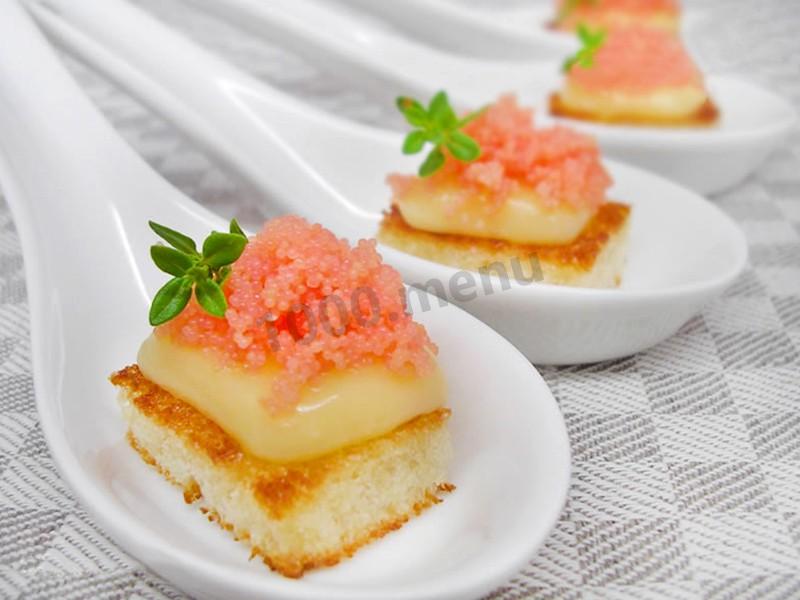
Gorgeous, tasty little bites for a party spread—give them a try! Capelin roe is simple to cure, and it tastes wonderful. Thanks to the beet, it also takes on a richer color. It looks great for dressing up party salads and all kinds of appetizers. And the appetizer I'm sharing in this recipe is my absolute favorite—beautiful to look at and delicious!
Mila-Mila
Recipe author
Toasts with Capelin Caviar
Nutrients and energy value of the composition of the recipe
By weight of the composition:
Proteins 20 %
4 g
Fats 50 %
10 g
Carbohydrates 30 %
6 g
125 kcal
GI:
0
/
71
/
29
- To make this pretty, tasty appetizer, we'll start by curing the caviar. It's not hard—here's how: 1. Put the caviar in a suitable container (ceramic is best). 2. Peel the beet and grate it on the coarse side of a grater. 3. Pour a third of the water into a saucepan and bring to a boil; add a third of the salt and a third of the grated beet, and cook 5 minutes over moderate heat. 4. Strain the brine through a fine sieve and pour it over the caviar. Let it sit 5 minutes, then strain the caviar through a sieve. 5. Boil water again, using half of the remaining water. Add the second third of the salt and grated beet, simmer a few minutes, strain the brine, pour it over the caviar for 10 minutes, then strain. 6. Repeat one more time. If the caviar's color comes out too intense, you can cover it with plain water and let it stand a bit—the color will leach out, but keep in mind the caviar will become not only less red but also less salty. The caviar is ready; on to the next step: 7. Heat the vegetable oil in a skillet and fry the bread slices in it. 8. Set the bread on a nice platter and, while it's still hot, lay a thick piece of hard cheese on each slice—you want the cheese to melt a little. 9. Top with the caviar and garnish each toast with a small sprig of thyme. Serve your caviar toasts for the party!
Caloric content of the products possible in the composition of the dish
- Beetroot - 40 kcal/100g
- Dried beetroot - 278 kcal/100g
- Boiled beets - 49 kcal/100g
- Dutch cheese - 352 kcal/100g
- Swiss cheese - 335 kcal/100g
- Russian cheese - 366 kcal/100g
- Kostroma cheese - 345 kcal/100g
- Yaroslavsky cheese - 361 kcal/100g
- Altai cheese 50% fat content - 356 kcal/100g
- Soviet cheese - 400 kcal/100g
- Cheese 'steppe' - 362 kcal/100g
- Uglich cheese - 347 kcal/100g
- Poshekhonsky cheese - 350 kcal/100g
- Lambert cheese - 377 kcal/100g
- Appnzeller cheese with 50% fat content - 400 kcal/100g
- Chester cheese with 50% fat content - 363 kcal/100g
- Edamer cheese with 40% fat content - 340 kcal/100g
- Cheese with mushrooms of 50% fat content - 395 kcal/100g
- Emmental cheese with 45% fat content - 420 kcal/100g
- Gouda cheese with 45% fat content - 356 kcal/100g
- Aiadeus cheese - 364 kcal/100g
- Dom blanc cheese (semi-hard) - 360 kcal/100g
- Lo spalmino cheese - 61 kcal/100g
- Cheese 'etorki' (sheep, hard) - 401 kcal/100g
- White cheese - 100 kcal/100g
- Fat yellow cheese - 260 kcal/100g
- Altai cheese - 355 kcal/100g
- Kaunas cheese - 355 kcal/100g
- Latvian cheese - 316 kcal/100g
- Limburger cheese - 327 kcal/100g
- Lithuanian cheese - 250 kcal/100g
- Lake cheese - 350 kcal/100g
- Gruyere cheese - 396 kcal/100g
- Thyme - 101 kcal/100g
- Dried thyme - 276 kcal/100g
- Thyme - 276 kcal/100g
- Vegetable oil - 873 kcal/100g
- Salt - 0 kcal/100g
- Water - 0 kcal/100g
- White bread - 266 kcal/100g
- Capelin caviar - 365 kcal/100g
Similar recipes
Related and additional categories:
- Festive table
- For breakfast
- Sandwiches
- Seafood
- Cheese
- Vegetables
- Bakery products
- Spices seasonings spices
- Fats and oils
- Other
- Wheat bread
- Salt
- Thyme
- Vegetable oil
- Water
- Frying
- Salting
- Breakfast sandwiches
- Cheese sandwiches
- Hot sandwiches
- Sandwiches for the festive table
- Birthday recipes
- New Year recipes
- Recipes for March 8
- Fish blanks
- Sandwiches for breakfast
- Caviar
- Made of solid cheese
- From beets
- Recipes for lean dishes without butter